Kuzzle Hypervision
Remote Water Meter Reading and Leak Detection
Water management is a proven IoT use case whose characteristics align particularly well with how private LoRaWAN networks operate: data transmitted at regular intervals, long sensor battery life, and small payload sizes. While the adoption rate of remote water meter reading is set to exceed half of France’s water meter base by 2035, the challenges of data governance and processing for these readings remain underestimated. How can data continuity be ensured regardless of sensor lifespan? How can data be anonymized in line with GDPR? Who can access the data in a shared framework? How is it quality-checked? For which indicators?
A highly fragmented set of management models
Whether managed directly (régie) or delegated (DSP), water management operates at very different territorial scales, from part of a single municipality to an entire département. Each scale comes with its own challenges.
They trust us
Kuzzle’s IoT, Data, and Hypervision platform addresses Smart City, Smart Building, Smart Industry, Smart Logistics & Transport, and Connected Healthcare use cases, as well as large-scale IoT data processing.






Better preservation of water resources while improving service to users
Remote water meter reading has become such a widely accepted practice that it will become a regulatory requirement under France’s Water Plan (Plan Eau) on 1 January 2027 because it offers substantial benefits for the environment, for subscribers, and for the staff of local authorities and/or their delegated operators.

More effective, real-time leak detection
Near-daily readings of water meter consumption indexes make it possible to identify abnormally high consumption spikes and quickly alert the subscriber, whether public, private, or residential.
Cross-referencing subscriber data with district metering (sectorisation) data also supports leak detection further upstream on the water network.

Better user relations through dynamic billing
Without remote metering, leaks and consumption spikes are typically only detected at billing time or during adjustments, which can be particularly painful for the subscriber. Remote metering makes it possible to move from annual or biannual billing to monthly billing, greatly reducing unpleasant surprises.

Safer field staff, redeployable to other missions
Thanks to remote reading, field staff can significantly cut back on manual meter-reading rounds, which are time-consuming and sometimes hazardous at certain meter locations.
Freeing up this workload makes it easier to redeploy staff to leak resolution on the network or to user-relations missions.
Ensuring data continuity between meter, module, manager, and subscriber
One might think that reading water meter indexes presents no particular difficulty. Yet the sheer volume of data, the range of user types, and the many configurable indicators make this a use case whose data exploitation potential we are only beginning to tap.
Structure your water meter reference database
Remote water meter reading is the most structurally demanding IoT use case in terms of volume across a territory: every public or private building, every home has a water meter to be read.
Structuring your reference database, distinguishing subscriber types, district meters, and production sites is a key step in laying the foundations of an effective project for preserving water resources.
Connect your remote reading modules
Switching a water meter fleet over to remote reading is a critical phase, with a deployment pace for modules specific to each water management syndicate, and the use of a low-bandwidth network such as LoRaWAN, whether dedicated or shared.
Tracking the progress of this rollout, monitoring module connectivity, cross-referencing data between sensors and the meter reference database, and distinguishing data across the different user types are all workstreams running in parallel with network infrastructure deployment, and they should not be neglected.
Ensure data quality and put your data to work
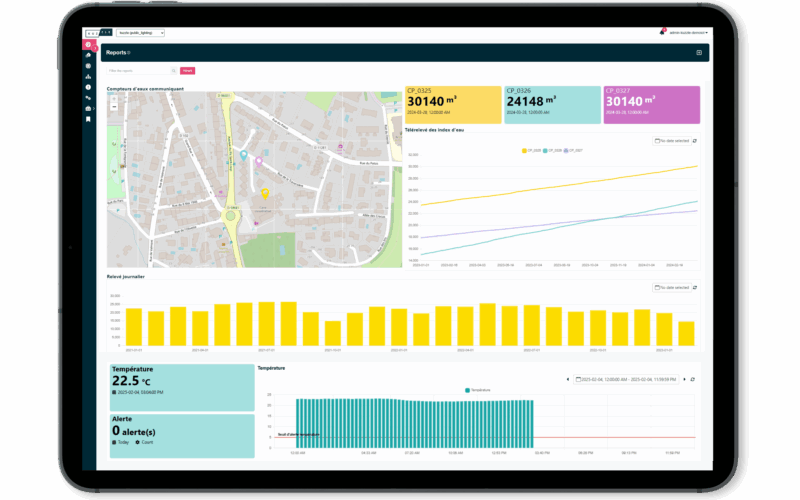
Reading water meters remotely is not “just” a billing matter. Addressing potential connectivity losses, identifying leaks through consumption spikes or minimum consumption thresholds, setting up the right alert process for each user type (residential/public/private), and maintaining a data history to anticipate the impact of certain climate events on water resource availability are all steps that justify deploying a data platform capable of elevating the work of field teams.
Let’s discuss your business challenges together!
At Kuzzle, every project starts with a conversation.
We take the time to understand your objectives, your constraints in the field, and your business priorities.
What makes the difference? A dedicated team that supports you from the initial question to the scaling-up phase.
Our experts help you clarify your priorities, identify your most impactful use cases, and structure your projects with complete confidence.
Your challenges are unique. Let’s discuss them together.
Many use cases to manage and steer your water cycle
The advantage of deploying a data and hypervision platform, compared with a conventional business tool for remote water metering, is the ability to grasp the entire water cycle, or at least the whole portion for which the local authority is responsible, within a single tool.
Subscriber metering
The visible tip of the iceberg, subscriber meter remote reading is the balancing point of many Connected and Sustainable Territory projects, guaranteeing a significant volume of sensors on publicly-led LoRaWAN networks.
Using the Kuzzle platform guarantees, for every local authority across the territory, data quality assurance, historization, interoperability, and exploitation options that adapt to their existing IT systems as well as to their different agent and subscriber profiles.
District metering (Sectorisation)
Accounting for an average of 2% of the subscriber meter base, district metering (sectorisation) is essential for facilitating leak detection on the network, where 20% of national water production is lost.
Thanks to Kuzzle’s data cross-referencing and analysis capabilities, the relevant teams can easily identify network sections potentially prone to leaks and become more efficient at preserving water resources.
Water reserve monitoring
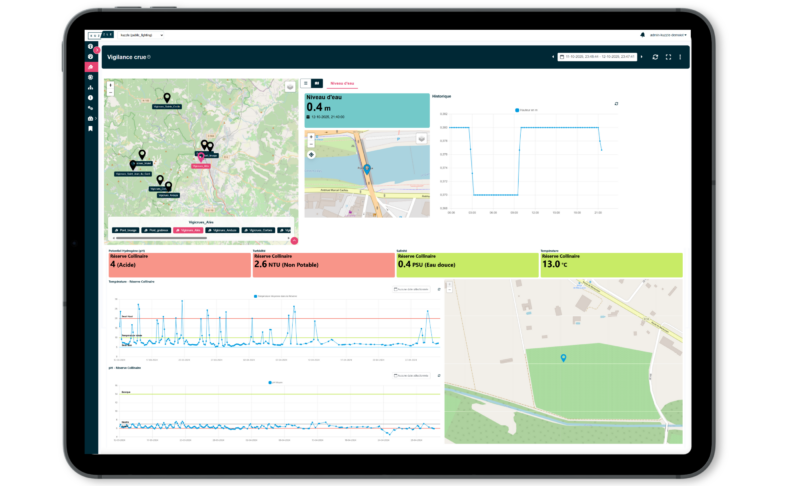
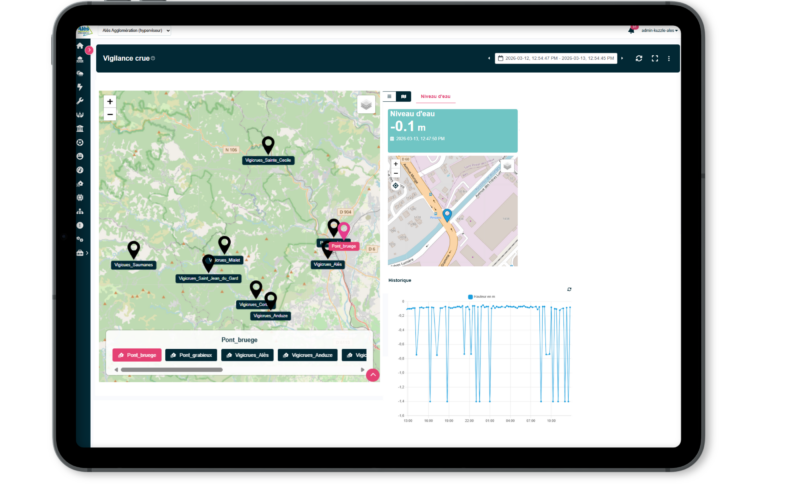
With almost all French départements now subject to drought orders and water abstraction restrictions, measuring water reserves is an essential indicator for shaping appropriate public policy.
Radar or infrared level sensors, piezometric probes, LoRaWAN or cellular connectivity, or data retrieval via API: whatever the measurement method, the Kuzzle platform collects, structures, and analyzes all your data.
Drinking water production monitoring
Limited visibility over the volumes actually produced in reservoirs or treatment plants, the difficulty of anticipating gaps between production, stock, and demand, particularly during periods of high consumption or seasonal events, and the lack of consolidated historical data upstream all make it difficult to coordinate with downstream needs and usage.
The Kuzzle platform cross-references water level and quality data in reserves, flow rates, and actual and forecast rainfall to anticipate and adjust abstraction and production cycles.
Infrastructure monitoring
The water network is not the only ageing component of the water cycle across French territory. The full range of infrastructure (dams, water towers, treatment plants, etc.) represents a sensitive asset base that IoT can help monitor effectively, provided the right measurement and analysis tools are in place.
This is precisely the value of the Kuzzle hypervision interface! The platform brings together heterogeneous data on both the infrastructure itself and how it evolves over time. It offers indicators, alerts, and reports tailored to field staff and elected officials to support decision-making and operations.
Valve control
Remote control of electric valves helps avoid time-consuming and costly manual interventions, while also enabling rapid action on the water network in the event of an anomaly, preventing overconsumption or material damage.
Beyond centralizing the sending of commands to open, close, or isolate zones, Kuzzle hypervision makes it possible to schedule, script, and log actions from a single interface.
Common Mistakes in Remote Water Meter Reading Projects
As with any use case combining data and connected devices, the pitfalls to avoid are at least as much about governance as about technical aspects. From choosing which indicators to track, to the conditions for scaling up, to allocating roles among stakeholders and integrating existing data, here is the essential checklist of what not to do in order to succeed with your remote water metering project.

Over-sizing your connectivity
The volume of connected meters brought by remote metering often underpins the economic balance of Connected Object Networks within Connected and Sustainable Territory projects. But for that balance not to come at the expense of network operators, the right network sizing must be found by taking into account the relatively low criticality of remote metering data: one successful transmission per month is enough to guarantee the minimum monthly billing objective.
Network densification comes at a later stage, as usage is pooled and data analysis is consolidated.

Overlooking how field staff handle manual reading
Understanding the day-to-day routine of staff dedicated to manual water meter reading, their travel constraints, and points of friction or safety risk, helps prioritize which zones should be switched over to remote reading first.
Counter-intuitively, it can be more cost-effective to prioritize deployment in an isolated hamlet that generates high travel costs, rather than in a dense urban center that is easier to read manually.

Neglecting the shift in field staff’s relationship with data
Remote metering saves significant time compared with manual reading, by reducing or even eliminating a time-consuming and sometimes hazardous task, and makes it possible to reallocate staff to other missions such as leak resolution or user relations.
But to deliver on its promise, it also requires staff who are comfortable working with data, able to analyze and challenge the information reported. Selecting the right profiles and providing training are key steps.

Overlooking the data question for smaller players in shared projects
The resources available to water sector players vary widely depending on their size. While delegated operators and large utilities have comprehensive information systems, smaller syndicates managing “only” a few hundred water meters are generally less well equipped, both technically and in terms of staffing.
For these players, a platform capable of adapting to existing resources and processing data upstream to make it easier to interpret is an additional success factor.

Lacking proactivity in managing leak alerts
Equipping meters with remote-reading modules, connecting them to a low-bandwidth network, structuring the data, and providing field staff with intuitive dashboards… only makes sense if, downstream, the process for handling data and alerts is embedded in the day-to-day work of the relevant teams.
Scripting how alerts are handled and managing acknowledgements are just as important as configuring dashboards and alert thresholds, and they form part of an ongoing improvement process to effectively combat leaks, both at the subscriber level and on the network.

Underestimating data reversibility
Keeping a history of subscriber consumption and billing data is part of daily life for water managers. However, the question of data portability at the end of a delegation contract (DSP) or when renewing a software contract can lead to significant extra costs, or even technical impossibilities.
Using an open platform with an Open Source core guarantees the local authority the portability and reversibility of its data, in line with the Data Act in force since September 2025.
Our latest success stories

Smart City
Smart Building Management
The Côte-d’Or Department (21) deployed, in record time, a demonstrator for the monitoring and automation of public buildings

Smart City
Territorial Hypervision
Development of a hypervision platform for monitoring air quality and electricity for the SIEA.

Smart City
Territorial hypervision platform
Real-time hypervisor for managing air quality and energy consumption in the Alès conurbation.
Expert support, clear indicators, measurable ROI.
At Kuzzle, we offer more than just a platform: we support you at every stage of your project, from defining your use cases to operational implementation and scaling up.
This approach guarantees you a solution that is truly tailored to your business challenges, capable of leveraging your data, streamlining your processes and producing concrete results.
Tailor-made support, closely aligned with your business realities.