Kuzzle Hypervision
Waste Management

Waste management, primarily through measuring fill levels at drop-off points (Voluntary Collection Points), is a use case particularly well suited to low-power public-initiative networks such as LoRaWAN: a responsibility typically shared at the level of an EPCI (intermunicipal body) or a joint association, measurement points spread across the entire territory, occasional readings a few times a day, and positive economic and environmental impacts thanks to the data generated.
To deliver on this promise, a solution capable of ensuring data quality and adapting to the different operating models of waste management authorities is key to project success, for local authorities and/or their operators, as well as for residents.
A responsibility with highly fragmented management models
Whether run in-house or delegated through a public service contract (DSP), waste management operates at very different territorial scales, ranging from part of a single municipality to an entire département. Each scale comes with its own challenges.
They trust us
Kuzzle’s IoT, Data, and Hypervision platform addresses Smart City, Smart Building, Smart Industry, Smart Logistics & Transport, and Connected Healthcare use cases, as well as large-scale IoT data processing.










More efficient, more cost-effectivewaste collection through fill-level data
Measuring PAV fill levels makes it possible to adapt collection schedules to actual usage rather than a fixed calendar. With an average 20% reduction in collection trips, the impact is significant across all types of local authorities, and especially notable in areas with challenging terrain and/or low population density.
Fewer overflowing bins and less illegal dumping
Reading the fill level of drop-off points identifies, in advance, those likely to overflow soon, allows their collection to be scheduled ahead of time, and, by extension, reduces illegal dumping around them due to lack of space inside. Beyond proving service efficiency, it’s also a visible improvement in residents’ living environment.

Fewer collection rounds and lower fuel consumption
Conversely, fixed-schedule collection has the drawback of emptying drop-off points that are only lightly filled, unnecessarily increasing collection time, fuel consumption, and vehicle mileage. The data generated adjusts routes and/or collection frequency based on actual fill levels.

Better oversight of operators’ contractual commitments
Tracking waste fill-level rates is essential data for overseeing the execution of public service contracts (DSP) when a local authority chooses to delegate collection to a private operator. Monitoring this data both ensures commitments are met, prevents out-of-contract services, and optimizes collection during the life of the contract.
Turning fill-level data into collection decisions
Going from level measurement to optimized waste collection involves several essential steps to secure reliable data upstream and draw the right decisions downstream. Adapting to existing infrastructure, different waste streams, and internal organizational models are all essential prerequisites.
Mapping and knowing your PAV network
Deriving a fill-level rate requires first knowing precisely the height of each drop-off point, its GPS position, the type of waste stream collected, and its collection schedule. When this data is already available through the local authority’s Open Data portal or GIS system, it’s a considerable time saver and an added guarantee of project success.
Measuring fill-level rates
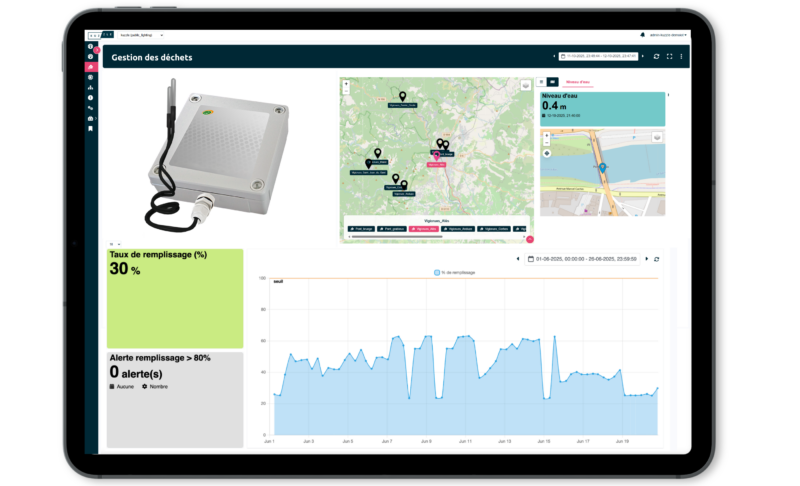
Level measurement can be carried out using various technologies, more or less costly and suited to the type of waste stream (household waste, packaging, glass, biowaste…): infrared, ultrasonic, or radar. This technical choice affects both data reliability and sensor maintenance requirements, and therefore has a significant impact on the overall economics of the project.
Ensuring data quality and putting it to use
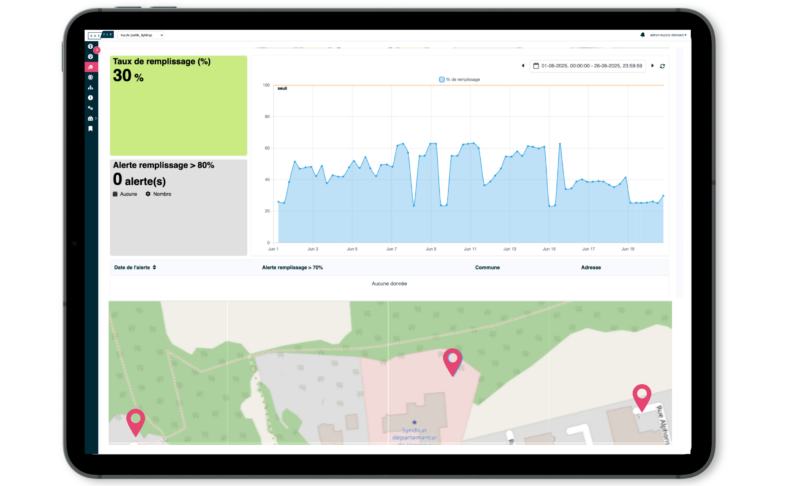
The drawback of low-power networks is that a single erroneous reading can lead to a poor collection decision. Smoothing fill-level data makes analyses and alerts more reliable, usable within the Kuzzle hypervision platform and exportable to the route-planning software used to calculate collection routes.
Let’s discuss your business challenges together!
At Kuzzle, every project starts with a conversation.
We take the time to understand your objectives, your constraints in the field, and your business priorities.
What makes the difference? A dedicated team that supports you from the initial question to the scaling-up phase.
Our experts help you clarify your priorities, identify your most impactful use cases, and structure your projects with complete confidence.
Your challenges are unique. Let’s discuss them together.
Fill-level tracking, whatever the type of waste
The strength of a hypervision platform like Kuzzle is that it’s agnostic to how data is collected: it measures any type of waste stream using the most suitable sensor, and consolidates this data with the PAV asset register and the business tools used to manage collection.
Household waste
Household waste, the category generating the most collections and, after bulky waste, the highest risk of illegal dumping, requires essential fill-level tracking to ensure efficient collection and cleanliness around drop-off points.
Household packaging and recyclable paper
The technical difficulty inherent in tracking fill levels at drop-off points dedicated to packaging and paper is that it only takes a piece of packaging to unfold and sit in front of the sensor to send an overestimated fill-level reading. Data quality processing smooths the readings received to avoid this kind of false positive.
Glass collection
The most widely recycled material, glass nevertheless involves a few subtleties when it comes to tracking fill levels: no infrared optical measurement, management of fill cones, and debris in the event of overflow.
Biowaste
Beyond fill level, biowaste tracking also relies on measuring temperature inside the bins, to limit strong odors that can lead to resident complaints.
Street litter bins
The efficiency of street litter bin collection matters all the more because it’s a highly visible reflection of local public services. In areas heavily exposed to wind, it also helps prevent litter from spreading into the environment.
Illegal dumping
For local authorities equipped with camera-based illegal dumping detection or a citizen reporting app, cross-referencing data on dumping incidents, PAV fill levels, and collection frequency enables a comprehensive response that goes beyond simple penalties.
Common mistakes in waste management projects
Simple on paper, fill-level tracking for drop-off points is the perfect use case to illustrate the need to master the entire IoT value chain to achieve the expected ROI: from measuring the distance between the sensor and the waste inside the PAV, to the interface offered to collection managers and truck drivers.

Not testing connectivity at every PAV
Depending on whether the PAV structure is plastic or metal, above ground or buried, whether the sensor has a remote antenna or not, and depending on network quality at its location, connectivity, and with it, the frequency of data updates, will be affected. Testing signal quality in advance makes it possible to choose the right connectivity option and anticipate downstream data quality measures.

Not adapting measurement technology to the waste stream
It’s tempting to buy in bulk by choosing a single sensor reference for an entire PAV network. But the most economical option, infrared, can’t be used on glass, which diffracts light and makes the data unusable, just as household waste and biowaste are more likely to be exposed to greater dirt, heat, and humidity. Choosing the right sensor type upfront avoids significant extra costs and malfunctions when scaling up.

Not planning for sensor maintenance
Few IoT sensors are exposed to conditions as harsh as waste sensors: rising temperatures from waste decomposition, friction, dirt, humidity, or even submersion during heavy rainfall. The question of responsibility for preventive and corrective maintenance must be addressed before data is put to use.

Underestimating the importance of knowing your PAV network
The fill-level rate is obtained by subtracting the measurement between the sensor and the waste from the measurement between the sensor and the bottom of the PAV. But this second measurement varies depending on the PAV model deployed. Applying a uniform height across the entire network without accounting for different PAV models risks generating underestimated fill levels, and therefore overflow risks, or overestimated ones, leading to costly empty collection runs for the local authority and its taxpayers.

Offering only one way to process fill-level data
Within the same territory, particularly at the départemental or intercommunal level, several management models can coexist between in-house operations and public service contracts (DSP). Each managing entity has its own tools, some with route-planning software, others without. Some will be satisfied with GPS coordinates of PAVs above a certain fill threshold at the start of a round, while others will want real-time alerts and access to a dynamic map. Adapting to these different scenarios avoids costly adjustments later on.

Only using data “in the moment”
PAV fill-level data adjusts collection rounds day to day. Longer-term historical data also provides valuable insight for identifying overflow peaks and each neighborhood’s needs by waste stream. Correlating this data with other tools, such as citizen reports, continuously improves the collection service, benefiting residents’ quality of life.
Our latest success stories

Smart City
Smart Building Management
The Côte-d’Or Department (21) deployed, in record time, a demonstrator for the monitoring and automation of public buildings

Smart City
Territorial Hypervision
Development of a hypervision platform for monitoring air quality and electricity for the SIEA.

Smart City
Territorial hypervision platform
Real-time hypervisor for managing air quality and energy consumption in the Alès conurbation.
Expert support, clear indicators, measurable ROI.
At Kuzzle, we offer more than just a platform: we support you at every stage of your project, from defining your use cases to operational implementation and scaling up.
This approach guarantees you a solution that is truly tailored to your business challenges, capable of leveraging your data, streamlining your processes and producing concrete results.
Tailor-made support, closely aligned with your business realities.