Smart City
Energy syndicate: Morbihan Énergies pools its regional data with Kuzzle’s data platform

A syndicate founded in 1965, now a driving force behind Morbihan’s energy and digital transitions
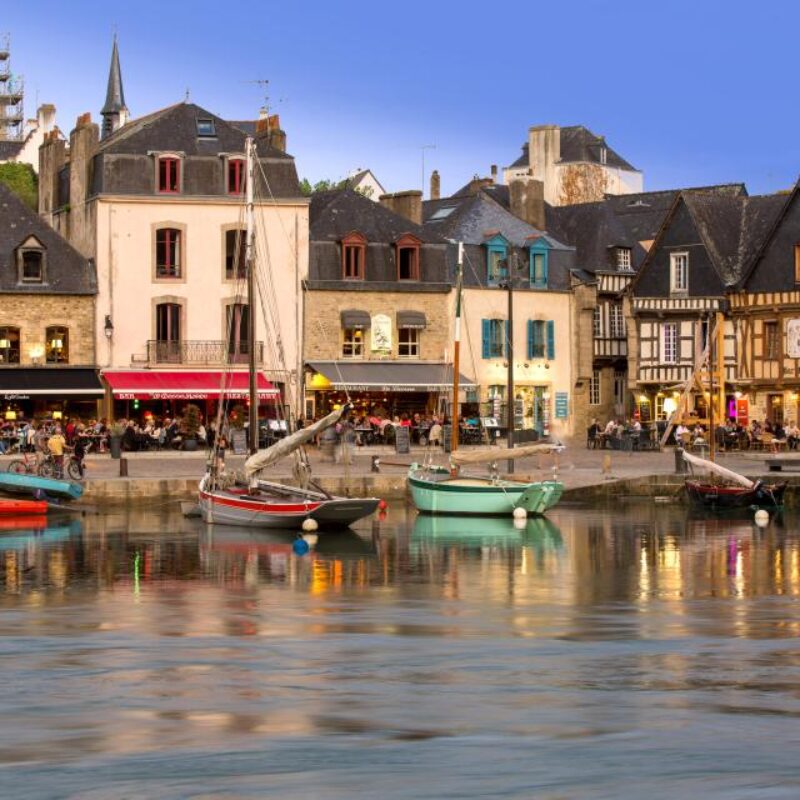
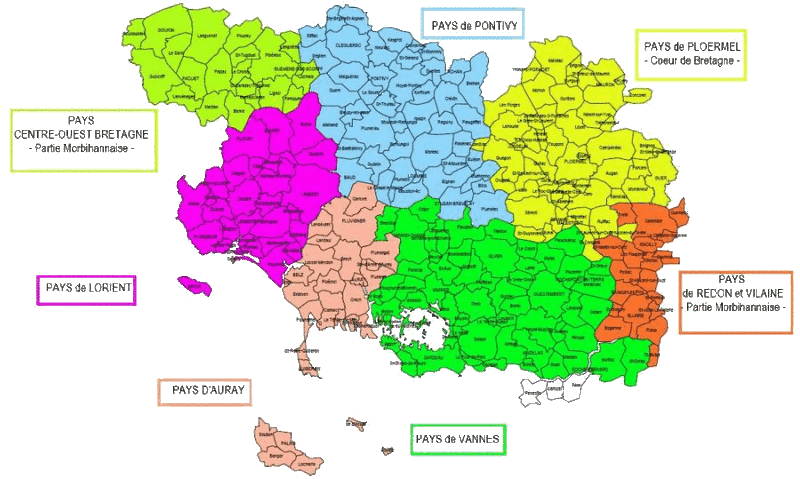
Based in Vannes, the syndicate organises and oversees electricity distribution for the department’s 249 municipalities, before gradually broadening its remit to renewable energy, low-carbon mobility, connected public lighting and smart buildings.
To support this diversification, the local authority relies on an open data platform, Kuzzle Data, complemented by Kuzzle’s IoT module for managing connected equipment, in order to centralise data from sensors, connected devices and existing systems.
This approach now allows Morbihan Énergies to connect several business domains within a single platform and make it available to member local authorities as a shared resource. This data platform forms a common foundation, complemented by Kuzzle IoT modules, to connect multiple local authorities and progressively roll out new use cases.
Over the years, the syndicate has been able to enrich the platform with new projects addressing the needs of its business lines and its members, while maintaining a shared, interoperable view of the region’s data.
The mutualisation challenges of Morbihan Énergies
Faced with the proliferation of sensors, hypervisors and business tools deployed across the region, the syndicate chose an open data platform to bring its data sources together without vendor lock-in, and to make this capability available to all of its member local authorities.
The context
A positive-energy region since 2015 and a winner of the Territoires d’innovation call for projects since 2019, Morbihan Énergies acts as a central purchasing body for the local authorities and public bodies in Morbihan that take part in its shared activity. The project therefore goes beyond the syndicate alone: it is a digital foundation designed to be shared across an entire department.
The syndicate has gradually broadened its role: renewable energy production, low-carbon mobility, connected public lighting, smart buildings, but also digital transition (open data, GDPR, shared GIS).
The challenge
On one side, a growing number of heterogeneous data sources: charging points, car-sharing, mobility flow cameras, connected public lighting, building energy-performance sensors — each with its own supervisor, its own format, its own vendor.
On the other, hypervisors that do valuable supervision work, but whose evolution comes at a cost: every new connector to build takes time and budget, and an “all-in-one” approach at the hypervisor level exposes the local authority to a closed ecosystem, dependent on a single vendor.
Morbihan Énergies needed a layer of abstraction: an open data platform able to collect, standardise and structure data just once, regardless of its source, then make it available to any hypervisor or visualisation tool on the market — without vendor lock-in and without starting from scratch with every new integration.

What the platform changes day to day
Rather than adding yet another tool, Morbihan Énergies chose a foundation able to talk to all the others. In practice, this means every department finds the data it needs without having to ask someone else for it or start from scratch on every new project.
A single view, whatever the source
Charging points, public lighting, building sensors: all of the region’s data arrives in one place, through connectors to market hypervisors and connected devices (Freshmile, Atomelec, UPCITI, Avob, and many others), without each department having to negotiate its own connector.
Hypervisors fed by the data
The platform talks to the hypervisors already in place: it consumes their data and feeds them new data in return via an open, secure API, without calling into question existing tools or investments already made.

Reliable data, accessible to everyone
Duplicates filtered out, inconsistent values detected, equipment catalogued through a dedicated connected-device management module (Device Manager): data is cleaned and structured once and for all. It is then exposed via secure APIs (OAuth2, JWT, OpenID Connect SSO) and real-time data streams, so each member local authority can consume the data relevant to it without depending on bespoke development for every request.

Autonomy and scalability
Because the platform is open source, Morbihan Énergies’ teams can audit the code, host it themselves and evolve it without depending on a vendor. It integrates with the tools already used by the syndicate’s IT department (Git, CI/CD) and lets internal teams extend it themselves, using common technologies (Angular, Vue.js, Flutter).
One platform, 4 regional use cases
Across its region, Morbihan Énergies structures its digital use cases around three priorities: equipment performance, traffic and footfall, and public safety. Four business areas illustrate this approach today:
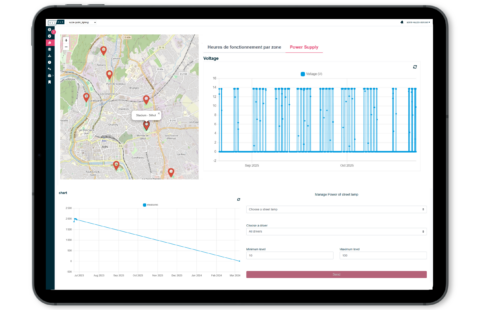
Connected public lighting
A network of more than 75,000 light points, managed from a single location. In 6 years, 16,000 lanterns have already been replaced and are now controlled by smart clocks. The platform lets teams monitor the state of the fleet in real time and anticipate maintenance work, for a better-managed annual budget of €10M.
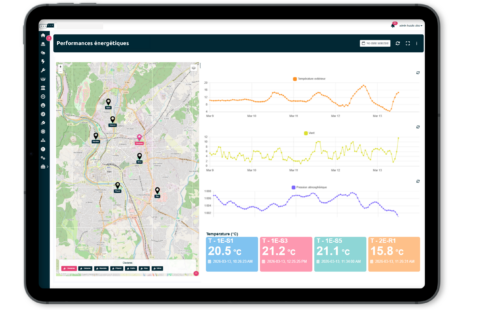
Building energy performance
In public buildings, understanding more in order to save more and improve safety: temperature, humidity, CO2, occupancy, intrusion… data collected from LoRa sensors (Avob) helps fine-tune comfort, spot consumption drifts and strengthen the security of premises. The goal: scale up from a handful of pilot sites to 250 sites.
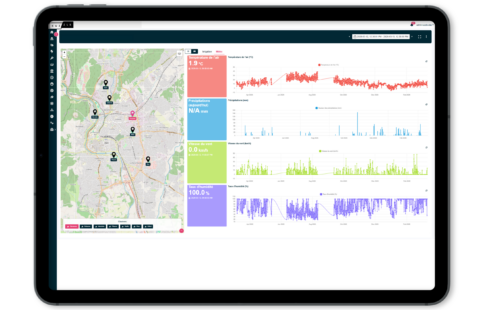
Electric mobility
230 charging points already installed, 40 more under study, with coverage designed so that no driver is ever more than 10 km from a charging point. Even more ambitious: in Vannes and on Belle-Île-en-Mer, the Flexmob’île project is trialling, with Renault, V2G charging points able to feed electricity from vehicle batteries back into the grid. Centralising this data lets teams track actual network usage and decide where and when to expand it.
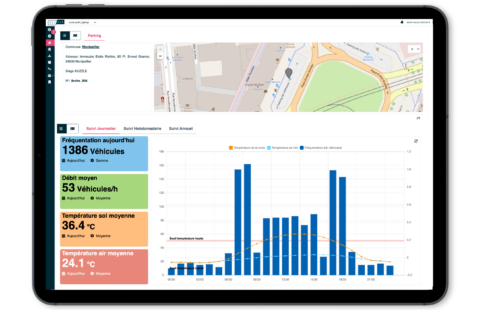
Mobility flows
UPCITI counting sensors track traffic flows across the region to anticipate infrastructure needs and inform mobility planning decisions.
Let’s discuss your operational challenges!
Every territory has its own infrastructure, constraints and priorities. Our teams support local authorities in setting up hypervision platforms tailored to their needs.
Your challenges are unique. Let’s talk about them.
A project with concrete benefits
For Morbihan Énergies and its member local authorities, the platform delivers:

Vendor independence
Data is collected and structured only once by Kuzzle’s data platform, then reusable by any current or future visualisation or management tool. This provides full interoperability with the region’s existing hypervisors, without calling into question the investments already made by the syndicate and its members.

Shared costs
Costs and effort are pooled at department level, with Morbihan Énergies acting as the central purchasing body for all of Morbihan’s member local authorities and public bodies.

Simplified scaling
A capacity to scale that has already been proven from the first pilot cases (with plans to expand from a handful of test sites to 250 sites for building energy-performance sensors, and to the entire department for traffic-flow sensors).

Evolution on demand
An open-source, scalable technical foundation on which new use cases, new data sources and new local authorities can be built over time, without starting from scratch or depending on a vendor’s choices.
With a budget of €80M, a syndicate board representing its 249 member municipalities and 13 member inter-municipal bodies, and more than 60 staff, Morbihan Énergies works to ensure reliable electricity distribution, effective public lighting and an ecological transition built on concrete action in renewable energy, low-carbon mobility and new digital tools.
Morbihan Énergies is a public body created in 1965 from the merger of the many inter-municipal syndicates that had been set up over the years to build the first rural electrification networks. A key partner to Morbihan’s elected officials, it responds to requests for assistance and advice and operates day to day across the department.
Today, this network spans more than 25,000 kilometres and forms the departmental and local “roads” of electricity, serving 530,000 consumers, both residential and business.
They trust us
The open-source IoT platform, Kuzzle IoT, addresses use cases in Smart City, Smart Building, Smart Industry, Smart Logistics & Transport, as well as in massive IoT data processing.










Our latest success stories

Smart City
Territorial Hypervision
Development of a hypervision platform for monitoring air quality and electricity for the SIEA.
Smart City
Territorial hypervision platform
Real-time hypervisor for managing air quality and energy consumption in the Alès conurbation.

Smart City
Smart Building Management
The Côte-d’Or Department (21) deployed, in record time, a demonstrator for the monitoring and automation of public buildings
Expert support, clear indicators, measurable ROI.
At Kuzzle, we go beyond technology: we support you at every stage of your project, from defining your use cases to operational implementation and scaling up.
This approach guarantees you a solution that is truly tailored to your business challenges, capable of leveraging your data, streamlining your processes and producing concrete results.
Tailor-made support, closely aligned with your business realities.